Recology has moved to Github, using Jekyll.
I just finished moving the Recology blog content, etc. to Github. This move is intended to make it easy to do exactly what I want with this blog without the constrictions of Blogger. Thanks for continuing to come back and read. I won't delete the Blogger version of this blog, but only new content will appear on the new site.
I haven't figured out how to get the RSS working yet, but I'm working on it.
Friday, January 6, 2012

Thursday, December 29, 2011
Weecology can has new mammal dataset
Recology has moved - go to http://recology.info/2011/12/weecology-can-has-new-mammal-dataset
So the Weecology folks have published a large dataset on mammal communities in a data paper in Ecology. I know nothing about mammal communities, but that doesn't mean one can't play with the data...
Their dataset consists of five csv files: communities, references, sites, species, and trapping data.
Where are these sites, and by the way, do they vary much in altitude?

Let's zoom in on just 'the states'?

What phylogenies can we get for the species in this dataset?
We can use the rOpenSci package treebase to search the online phylogeny repository TreeBASE. Limiting to returning a max of 1 tree (to save time), we can see that X species are in at least 1 tree on the TreeBASE database. Nice.
So there are 321 species in the database with at least 1 tree in the TreeBASE database. Of course there could be many more, but we limited results from TreeBASE to just 1 tree per query.
Here's the code:
So the Weecology folks have published a large dataset on mammal communities in a data paper in Ecology. I know nothing about mammal communities, but that doesn't mean one can't play with the data...
Their dataset consists of five csv files: communities, references, sites, species, and trapping data.
Where are these sites, and by the way, do they vary much in altitude?

Let's zoom in on just 'the states'?

What phylogenies can we get for the species in this dataset?
We can use the rOpenSci package treebase to search the online phylogeny repository TreeBASE. Limiting to returning a max of 1 tree (to save time), we can see that X species are in at least 1 tree on the TreeBASE database. Nice.
So there are 321 species in the database with at least 1 tree in the TreeBASE database. Of course there could be many more, but we limited results from TreeBASE to just 1 tree per query.
Here's the code:
Friday, December 23, 2011
Recology is 1 yr old...
Recology has moved, go to http://recology.info/2011/12/recology-is-1-yr-old
This blog has lasted a whole year already. Thanks for reading and commenting.
There are a couple of announcements:
Anywho, here is the breakdown of visits to this blog, visualized using #ggplot2, of course. There were a total of about 23,000 pageviews in the first year of this blog. Here is the pie chart code I used:
Visits to top ten posts:

Visits by by pages:

Visits by top referring sites:

Visits by country:

Visits by browsers:

Visits by operating system:

This blog has lasted a whole year already. Thanks for reading and commenting.
There are a couple of announcements:
- Less blogging: I hope to put in many more years blogging here, but in full disclosure, I am blogging for Journal of Ecology now, so I am going to be (and already have been) blogging less here.
- More blogging: If anyone wants to write guest posts at Recology on the topics of using R for ecology and evolution, or open science, please contact me!
- Different blogging: I was going to roll out the new dynamic views for this blog, but Google doesn't allow javascript, which is how I include code using GitHub gists. Oh well...
Anywho, here is the breakdown of visits to this blog, visualized using #ggplot2, of course. There were a total of about 23,000 pageviews in the first year of this blog. Here is the pie chart code I used:
Visits to top ten posts:

Visits by by pages:

Visits by top referring sites:

Visits by country:

Visits by browsers:

Visits by operating system:

Thursday, December 22, 2011
Dynamic views don't support javascript-so reverting back to simple views
Sorry for the temporary loss of GitHub gists...Hopefully dynamic views will support javascript soon!!
Tuesday, December 13, 2011
I Work For The Internet !
Recology has moved, go to http://recology.info/2011/12/i-work-for-internet
UPDATE: code and figure updated at 647 AM CST on 19 Dec '11. Also, see Jarrett Byrnes (improved) fork of my gist here.
The site I WORK FOR THE INTERNET is collecting pictures and first names (last name initials only) to show collective support against SOPA (the Stop Online Piracy Act). Please stop by their site and add your name/picture.
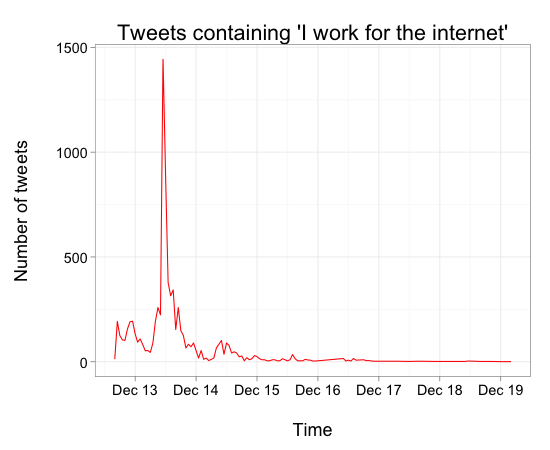
I used the #rstats package twitteR, created by Jeff Gentry, to search for tweets from people signing this site with their picture, then plotted using ggplot2, and also used Hadley's lubridate to round timestamps on tweets to be able to bin tweets in to time slots for plotting.
Tweets containing the phrase 'I work for the internet' by time:

UPDATE: code and figure updated at 647 AM CST on 19 Dec '11. Also, see Jarrett Byrnes (improved) fork of my gist here.
The site I WORK FOR THE INTERNET is collecting pictures and first names (last name initials only) to show collective support against SOPA (the Stop Online Piracy Act). Please stop by their site and add your name/picture.
I used the #rstats package twitteR, created by Jeff Gentry, to search for tweets from people signing this site with their picture, then plotted using ggplot2, and also used Hadley's lubridate to round timestamps on tweets to be able to bin tweets in to time slots for plotting.
Tweets containing the phrase 'I work for the internet' by time:
Here's the code as a GitHub gist. Sometimes the searchTwitter fxn doesn't returns an error, which I don't understand, but you can play with it:
Wednesday, November 30, 2011
rOpenSci won 3rd place in the PLoS-Mendeley Binary Battle!
Recology has moved go to http://recology.info/2011/11/ropensci-won-3rd-place-in-plos-mendeley
I am part of the rOpenSci development team (along with Carl Boettiger, Karthik Ram, and Nick Fabina). Our website: http://ropensci.org/. Code at Github: https://github.com/ropensci
We entered two of our R packages for integrating with PLoS Journals (rplos) and Mendeley (RMendeley) in the Mendeley-PLoS Binary Battle. Get them at GitHub (rplos; RMendeley).
These two packages allow users (from R! of course) to search and retrieve data from PLoS journals (including their altmetrics data), and from Mendeley. You could surely mash up data from both PLoS and Mendeley. That's what's cool about rOpenSci - we provide the tools, and leave it up to users vast creativity to do awesome things.
3rd place gives us a $1,000 prize, plus a Parrot AR Drone helicopter.
Saturday, November 19, 2011
Friday, November 18, 2011
My talk on doing phylogenetics in R
Recology has moved, go to http://recology.info/2011/11/my-talk-on-doing-phylogenetics-in-r
I gave a talk today on doing very basic phylogenetics in R, including getting sequence data, aligning sequence data, plotting trees, doing trait evolution stuff, etc.
Please comment if you have code for doing bayesian phylogenetic inference in R. I know phyloch has function mrbayes, but can't get it to work...
I gave a talk today on doing very basic phylogenetics in R, including getting sequence data, aligning sequence data, plotting trees, doing trait evolution stuff, etc.
Please comment if you have code for doing bayesian phylogenetic inference in R. I know phyloch has function mrbayes, but can't get it to work...
Tuesday, November 1, 2011
Check out a video of my research at RocketHub
Recology has moved, go to http://recology.info/check-out-video-of-my-research-at
Okay, so this post isn't at all about R - but I can't resist begging my readers for some help.
I’m trying to get some crowdfunding for my research on the evolution of native plants in agricultural landscapes. My campaign is part of a larger project by about 50 other scientists and me to see how well it works to go straight to the public to get funding for science research. All these projects, including mine, are hosted at a site called RocketHub - a site that hosts crowdfunding projects of all sorts – and now they have science.
It is important to get a few bucks at the beginning so that the people that don’t know me with deep pockets will hopefully chip in once they see the money ball rolling.
The funding will go towards paying some students to collect data in the lab for me.
Here’s the link if you want to donate, or just to check out the video I made about my research!
http://www.rockethub.com/projects/3790-evolution-in-agriculture
And watch the video here too:
Okay, so this post isn't at all about R - but I can't resist begging my readers for some help.
I’m trying to get some crowdfunding for my research on the evolution of native plants in agricultural landscapes. My campaign is part of a larger project by about 50 other scientists and me to see how well it works to go straight to the public to get funding for science research. All these projects, including mine, are hosted at a site called RocketHub - a site that hosts crowdfunding projects of all sorts – and now they have science.
It is important to get a few bucks at the beginning so that the people that don’t know me with deep pockets will hopefully chip in once they see the money ball rolling.
The funding will go towards paying some students to collect data in the lab for me.
Here’s the link if you want to donate, or just to check out the video I made about my research!
http://www.rockethub.com/projects/3790-evolution-in-agriculture
And watch the video here too:
Friday, October 28, 2011
My little presentation on getting web data through R
Recology has moved, go to http://recology.info/my-little-presentation-on-getting-web
With examples from rOpenSci R packages. p.s. I am no expert at this...
Web data from R
With examples from rOpenSci R packages. p.s. I am no expert at this...
Web data from R
View more presentations from schamber
Thursday, October 27, 2011
Two new rOpenSci R packages are on CRAN
Recology has moved, go to http://recology.info/2011/10/two-new-ropensci-r-packages-are-on-cran
Carl Boettiger, a graduate student at UC Davis, just got two packages on CRAN. One is treebase, which which handshakes with the Treebase API. The other is rfishbase, which connects with the Fishbase, although I believe just scrapes XML content as there is no API. See development on GitHub for treebase here, and for rfishbase here. Carl has some tutorials on treebase and rfishbase at his website here, and we have an official rOpenSci tutorial for treebase here.
Basically, these two R packages let you search and pull down data from Treebase and Fishbase - pretty awesome. This improves workflow, and puts your data search and acquisition component into your code, instead of being a bunch of mouse clicks in a browser.
These two packages are part of the rOpenSci project.
Carl Boettiger, a graduate student at UC Davis, just got two packages on CRAN. One is treebase, which which handshakes with the Treebase API. The other is rfishbase, which connects with the Fishbase, although I believe just scrapes XML content as there is no API. See development on GitHub for treebase here, and for rfishbase here. Carl has some tutorials on treebase and rfishbase at his website here, and we have an official rOpenSci tutorial for treebase here.
Basically, these two R packages let you search and pull down data from Treebase and Fishbase - pretty awesome. This improves workflow, and puts your data search and acquisition component into your code, instead of being a bunch of mouse clicks in a browser.
These two packages are part of the rOpenSci project.
Wednesday, October 26, 2011
Two-sex demographic models in R
Recology has moved, go to http://recology.info/2011/10/two-sex-demographic-models-in-r
Tom Miller (a prof here at Rice) and Brian Inouye have a paper out in Ecology (paper, appendices) that confronts two-sex models of dispersal with empirical data.
They conducted the first confrontation of two-sex demographic models with empirical data on lab populations of bean beetles Callosobruchus.
Their R code for the modeling work is available at Ecological Archives (link here).
Here is a figure made from running the five blocks of code in 'Miller_and_Inouye_figures.txt' that reproduces Fig. 4 (A-E) in their Ecology paper (p = proportion female, Nt = density). Nice!
A: Saturating density dependence
B: Over-compensatory density dependence
C: Sex-specific gamma's (but bM=bF=0.5)
D: Sex-specific b's (but gammaM=gammaF=1)
E: Sex-specific b's (but gammaM=gammaF=2)

Tom Miller (a prof here at Rice) and Brian Inouye have a paper out in Ecology (paper, appendices) that confronts two-sex models of dispersal with empirical data.
They conducted the first confrontation of two-sex demographic models with empirical data on lab populations of bean beetles Callosobruchus.
Their R code for the modeling work is available at Ecological Archives (link here).
Here is a figure made from running the five blocks of code in 'Miller_and_Inouye_figures.txt' that reproduces Fig. 4 (A-E) in their Ecology paper (p = proportion female, Nt = density). Nice!
A: Saturating density dependence
B: Over-compensatory density dependence
C: Sex-specific gamma's (but bM=bF=0.5)
D: Sex-specific b's (but gammaM=gammaF=1)
E: Sex-specific b's (but gammaM=gammaF=2)

Friday, October 14, 2011
New food web dataset
Recology has moved, go to http://recology.info/2011/10/new-food-web-dataset
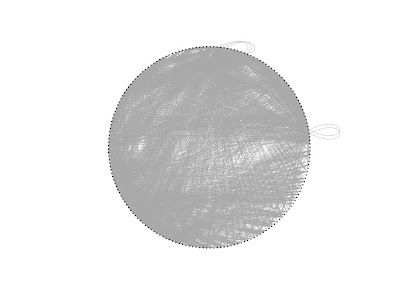
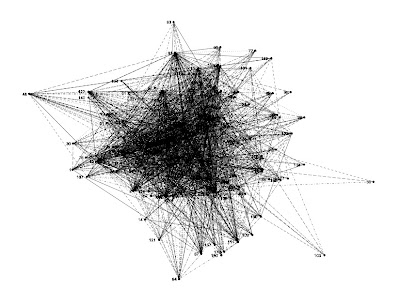
So, there is a new food web dataset out that was put in Ecological Archives here, and I thought I would play with it. The food web is from Otago Harbour, an intertidal mudflat ecosystem in New Zealand. The web contains 180 nodes, with 1,924 links.
Fun stuff...

So, there is a new food web dataset out that was put in Ecological Archives here, and I thought I would play with it. The food web is from Otago Harbour, an intertidal mudflat ecosystem in New Zealand. The web contains 180 nodes, with 1,924 links.
Fun stuff...
igraph, default layout plot

igraph, circle layout plot, nice

My funky little gggraph function plot
get the gggraph function, and make it better, here at Github

Thursday, October 13, 2011
Phylogenetic community structure: PGLMMs
Recology has moved, go to http://recology.info/2011/10/phylogenetic-community-structure-pglmms
So, I've blogged about this topic before, way back on 5 Jan this year.
Matt Helmus, a postdoc in the Wootton lab at the University of Chicago, published a paper with Anthony Ives in Ecological Monographs this year (abstract here). The paper addressed a new statistical approach to phylogenetic community structure.
As I said in the original post, part of the power of the PGLMM (phylogenetic generalized linear mixed models) approach is that you don't have to conduct quite so many separate statistical tests as with the previous null model/randomization approach.
Their original code was written in Matlab. Here I provide the R code that Matt has so graciously shared with me. There are four functions and a fifth file has an example use case. The example and output are shown below.
Look for the inclusion of Matt's PGLMM to the picante R package in the future.
Here are links to the files as GitHub gists:
PGLMM.data.R: https://gist.github.com/1278205
PGLMM.fit.R: https://gist.github.com/1284284
PGLMM.reml.R: https://gist.github.com/1284287
PGLMM.sim.R: https://gist.github.com/1284288
PGLMM_example.R: https://gist.github.com/1284442
Enjoy!
The example
..and the figures...


So, I've blogged about this topic before, way back on 5 Jan this year.
Matt Helmus, a postdoc in the Wootton lab at the University of Chicago, published a paper with Anthony Ives in Ecological Monographs this year (abstract here). The paper addressed a new statistical approach to phylogenetic community structure.
As I said in the original post, part of the power of the PGLMM (phylogenetic generalized linear mixed models) approach is that you don't have to conduct quite so many separate statistical tests as with the previous null model/randomization approach.
Their original code was written in Matlab. Here I provide the R code that Matt has so graciously shared with me. There are four functions and a fifth file has an example use case. The example and output are shown below.
Look for the inclusion of Matt's PGLMM to the picante R package in the future.
Here are links to the files as GitHub gists:
PGLMM.data.R: https://gist.github.com/1278205
PGLMM.fit.R: https://gist.github.com/1284284
PGLMM.reml.R: https://gist.github.com/1284287
PGLMM.sim.R: https://gist.github.com/1284288
PGLMM_example.R: https://gist.github.com/1284442
Enjoy!
The example
..and the figures...


Thursday, October 6, 2011
R talk on regular expressions (regex)
Recology has moved, go to http://recology.info/2011/10/r-talk-on-regular-expressions-regex
Regular expressions are a powerful in any language to manipulate, search, etc. data.
For example:
R base has many functions for regular expressions, see slide 9 of Ed's talk below. The package stringr, created by Hadley Wickham, is a nice alternative that wraps the base regex functions for easier use. I highly recommend stringr.
Ed Goodwin, the coordinator of the Houston R Users group, gave a presentation to the group last night on regular expressions in R. It was a great talk, and he is allowing me to post his talk here.
Enjoy! And thanks for sharing Ed!
Regular expressions are a powerful in any language to manipulate, search, etc. data.
For example:
R base has many functions for regular expressions, see slide 9 of Ed's talk below. The package stringr, created by Hadley Wickham, is a nice alternative that wraps the base regex functions for easier use. I highly recommend stringr.
Ed Goodwin, the coordinator of the Houston R Users group, gave a presentation to the group last night on regular expressions in R. It was a great talk, and he is allowing me to post his talk here.
Enjoy! And thanks for sharing Ed!
Friday, September 30, 2011
R tutorial on visualizations/graphics
Recology has moved, go to http://recology.info/2011/09/r-tutorial-on-visualizationsgraphics
Rolf Lohaus, a Huxley postdoctoral fellow here in the EEB dept at Rice University, gave our R course a talk on basic visualizations in R this morning.
Enjoy!
Rolf Lohaus, a Huxley postdoctoral fellow here in the EEB dept at Rice University, gave our R course a talk on basic visualizations in R this morning.
Enjoy!
Tuesday, September 27, 2011
Short on funding? Can't get a grant? Crowdfunding! #SciFund
Recology has moved, go to http://recology.info/2011/09/short-on-funding-cant-get-grant
Crowdsourced funding is becoming a sustainable way for various artists, entrepreneurs, etc. to get their idea funded from individuals. For example, think of Kickstarter and RocketHub.
Jai Ranganathan and Jarrett Byrnes have started an experiment to determine how well crowdfunding can work for scientists: The SciFund Challenge. Go here to signup and here for their website.
The deadline to sign up is Oct. 1
Crowdsourced funding is becoming a sustainable way for various artists, entrepreneurs, etc. to get their idea funded from individuals. For example, think of Kickstarter and RocketHub.
Jai Ranganathan and Jarrett Byrnes have started an experiment to determine how well crowdfunding can work for scientists: The SciFund Challenge. Go here to signup and here for their website.
The deadline to sign up is Oct. 1
Friday, September 23, 2011
Thursday, September 22, 2011
@drewconway interview on @DataNoBorders at the Strata conference
Recology has moved, go to http://recology.info/2011/09/drewconway-interview-on-datanoborders
The O'Reilly Media Strata Summit has many interviews on YouTube (just search YouTube for it)
Drew Conway is the author of a R packages, including infochimps, an R wrapper to the Infochimps API service.
The YouTube video:
The O'Reilly Media Strata Summit has many interviews on YouTube (just search YouTube for it)
Drew Conway is the author of a R packages, including infochimps, an R wrapper to the Infochimps API service.
The YouTube video:
Open science talk by Carl Boettiger
Recology has moved, go to http://recology.info/2011/09/open-science-talk-by-carl-boettiger
Carl Boettiger gave a talk on the topic of open science to incoming UC Davis graduate students.
Here is the audio: http://www.archive.org/details/ThingsIWishIKnewThreeYearsAgo-ByTheDavisOpenScienceGroup&reCache=1
Here are the slides: http://hazelnusse.github.com/DOS_WOW2011/#title-slide
Carl Boettiger gave a talk on the topic of open science to incoming UC Davis graduate students.
Here is the audio: http://www.archive.org/details/ThingsIWishIKnewThreeYearsAgo-ByTheDavisOpenScienceGroup&reCache=1
Here are the slides: http://hazelnusse.github.com/DOS_WOW2011/#title-slide
Subscribe to:
Posts (Atom)